

In the Pod of Capricorn universe, Capricorn is a generation ship — a colony wheel — that’s been travelling for thousands of years across the stars. (It’s also the name of the AI that runs the ship.)
When writing Between Two Worlds and its sequel, I knew I’d need a firm grasp on the geography of Capricorn. My initial first-draft groping world-building put the major features in place but my inner geek needed more. What does the wheel look like, exactly? How big is it? What are the constituent parts called, and how big are they? How fast does it rotate? What words do the inhabitants use for navigation? How would they orient themselves? Where does the light come from?
I knew the wheel would be a type of Stanford torus — a flying doughnut. Here’s the classic image:

But how does this translate to Between Two Worlds?
Capricorn
Capricorn is much bigger than the torus in the fantastic illustration above. With the help of maths and hand-waving I settled on a torus with a major radius of about 130 km. That supports 10 sectors, each 80 km along its arc.
Yes, this is big.
The minor radius (the edible part of the doughnut) is 5 km. That gives each sector a living space of around 800 km². The walls that separate each sector — at the base of the spokes — are 1 km thick.
To provide Earth-normal-ish gravity, the wheel rotates once every 30 seconds. (I think I got the maths right here, but if I didn’t I don’t care, it doesn’t matter.)
The hub at the centre of the wheel has a radius of about 17 km. I don’t remember why I settled on that figure, but it might be related to the apparent size of the Sun in the sky of Earth. Again, I fully expect my maths here to be (technical term) shonky, but it doesn’t matter.
There’s a strip around the centre of the hub, aligned with the doughnut, that provides light. A quarter of this strip is always lit, and segments switch on and off so the strip appears to revolve around the hub once a day. This gives each place on the “ground” an illusion of sunrise and sunset.
There’s an important caveat: midday in one location is midnight at the opposite side of the wheel, and during the night there’ll undoubtedly be significant nightshine from the sectors in daylight.
All that discussion gives a wheel that looks like this:

I created this in Blender, mostly by poking at it from a distance with a stick. Blender has an API, so I wrote a Python script that creates all the parts, assembles them, and subtracts about a year from my life.
If you look closely at the above image you’ll see that the inhabited doughnut part of the wheel isn’t a doughnut: I sliced away the “air and roof” of the inhabited area so what you see is the “ground” where people live. I do have “air and roof” toruses in the Blender scene but they tend to get in the way, so I usually hide them. Here’s what the wheel looks like, with and without a roof on the tube:


I added the starfield primarily to help create marketing materials, and that’s also why I figured out how to animate parts of the scene: I can fly the camera around and spin the wheel against the stars. This proved surprisingly useful for the manuscript too, as I could position and point the camera to show exactly how Pod would see the stars moving beyond the fixed parts of the wheel.
I’ve created a movie to show what I mean. Look around the wheel one way, and stars appear to move down; the other way, they move up; look out of the wheel one way, the stars rotate anticlockwise; the other way, clockwise; look up to the hub, and they sweep past.
The movie is exactly 30 seconds long, the rotation time of Capricorn within the Blender cinematic universe, which means it loops seamlessly.
I could watch this for hours.
Early in the book Pod sits and “watches the spin” as he calls it. I wrote that line long before I made any renders like this. Funny how that works.
Terminology
That’s the author view of Capricorn: the god view, if you like. What about the Pod view: how do Pod and the other inhabitants see the wheel?
I haven’t and won’t attempt to create a full 3D render of the wheel, with towns and fields and lakes and everything. I’m not good enough at wrangling Blender (and don’t want to use AI to do it).
To be honest I like the green wireframe look — it fits the diagrams I need for the book interior, and anything else would be immense effort for little return.
Talking of diagrams, here’s what you’ll see in the book before the story starts. These diagrams introduce the most important terms used by the residents of Capricorn for parts of the wheel and for navigation.

First, the big picture. Pod and his friends live in Ossi sector. Each sector occupies a tenth of the circumference of the wheel – between two spokes, as it were. One sector, Suncass, is greyed out. I wonder why?
From this perspective, the wheel rotates anticlockwise: that’s spinward in Capricorn Basic, my name for the dialect the residents use. The opposite direction is spoutward, because everyone loves a stupid pun.

Wherever you stand on Capricorn, you’re at the six — you’re at the bottom of the clockface. Both spinward and spoutward from you, the wheel curves up, and the twelve is always directly above you, behind the hub where you can’t see it. If you want to point someone to a location around the wheel, you’d say it’s at the eight or at the three, and they’d know what you mean. The spokes of the wheel obscure the detail but people are used to that.

Zooming in, here’s the central hub and the source of light — the sunstrip. The spokes of the wheel are called ladders, and they’re made of Xs.

At the base of each ladder there’s a semicircular wall a kilometre thick and ten kilometres in diameter – reaching from the “ground” to the “roof” of the doughnut. A wall separates a sector from its neighbour. Sectors aren’t isolated: there’s a way through the wall to the next sector, easy to lock down in an emergency.

At the sector level where people live, many common terms exist. The “ground” is the tread. The axis is not one of rotation, but of reflection: it’s the centre line of the tread. It’s not visible here but the tread curves gently up from the axis to the rims, the edges either side. Local geography, lumps and bumps in the landscape, obscure that curve but it’s evident when you look across the tread to the opposite side.
Moving away from the axis is going uptread; moving towards the axis is going downtread. As well as spinward and spoutward, there are narv and sove, the Capricorn Basic versions of north and south. The words west and east could be used instead of spinward and spoutward, but they’re considered laughably outdated. As one person says in the book: “Going spoutward. Called it east like a nelder nelder.”
You can always tell if you’re facing spoutward, spinward, narv or sove, by the direction the stars appear to be moving. See the video earlier!
In a future post I’ll include a basic map of Ossi. In the book, the map is split into three because 8×1 is not a friendly aspect ratio for a paperback or an ebook reader.
Is there anything you’d like to know about the geography of Capricorn? Let me know in the comments.

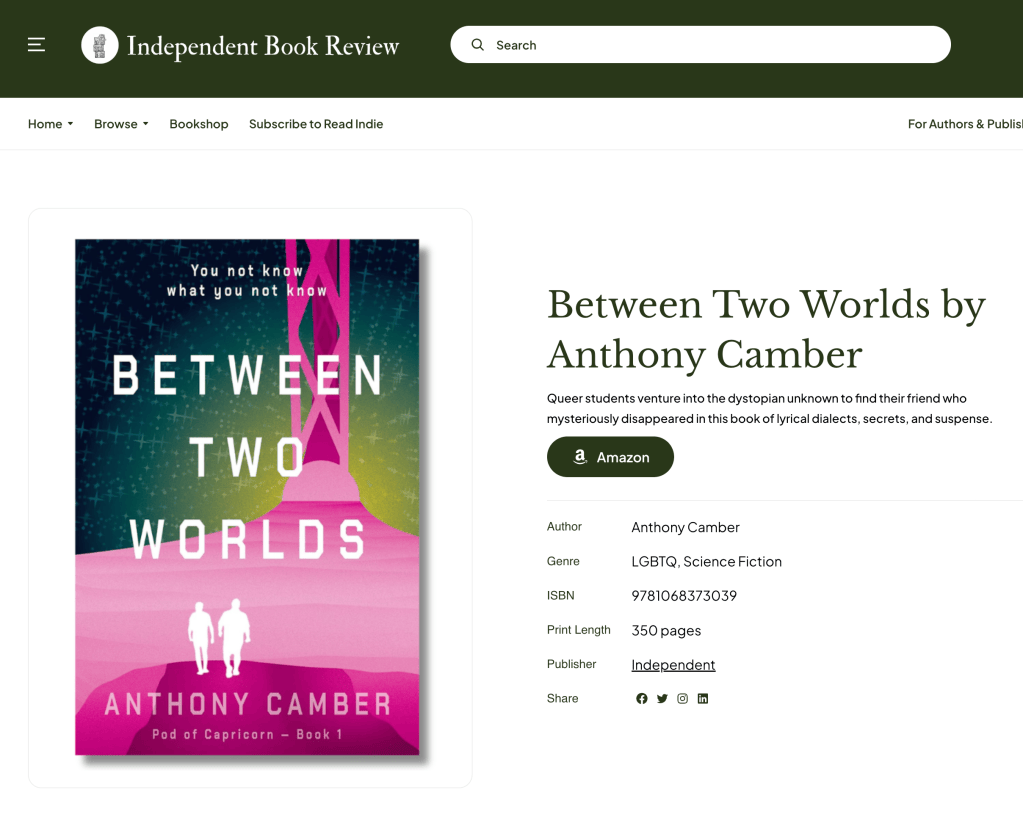
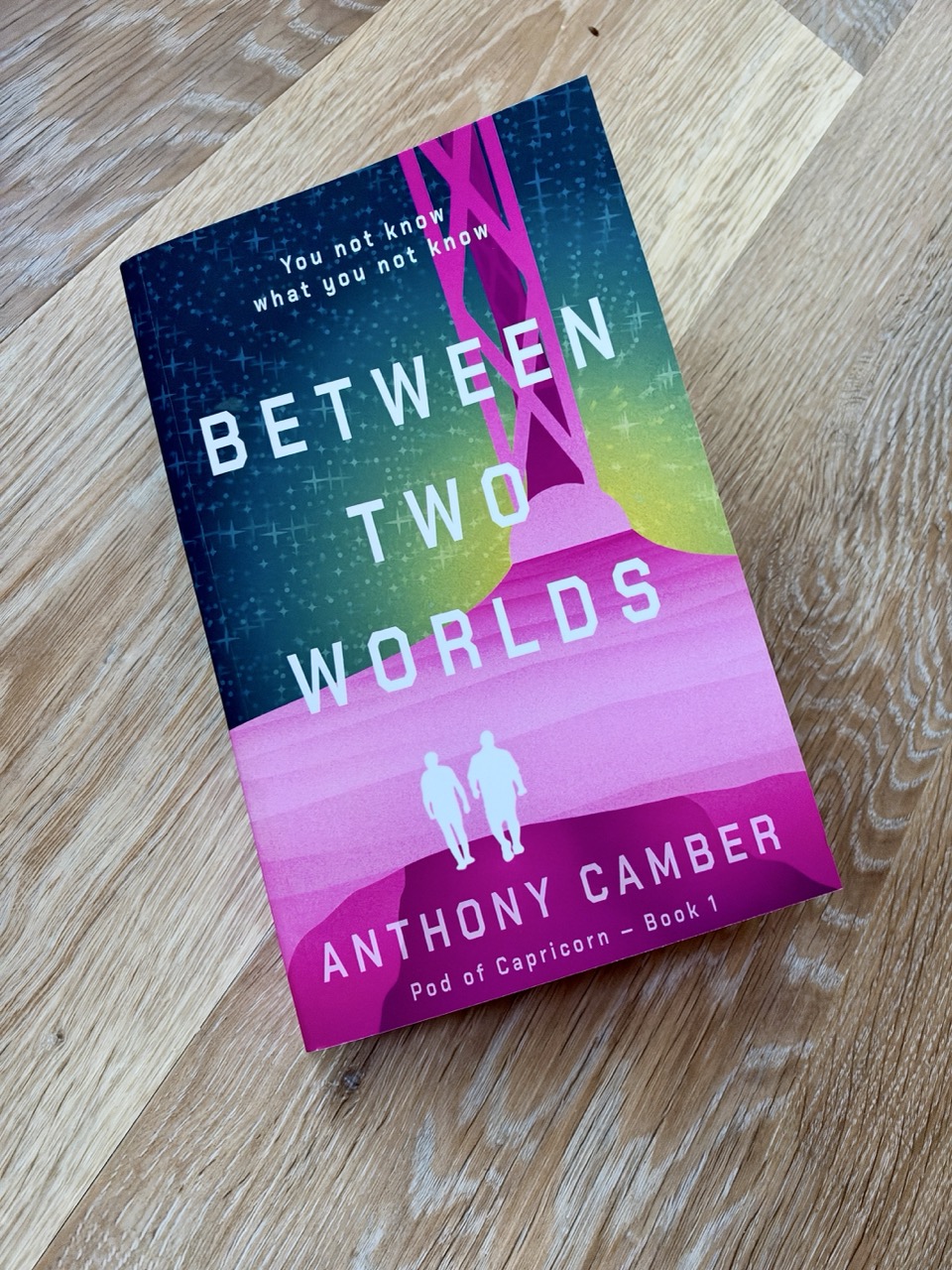
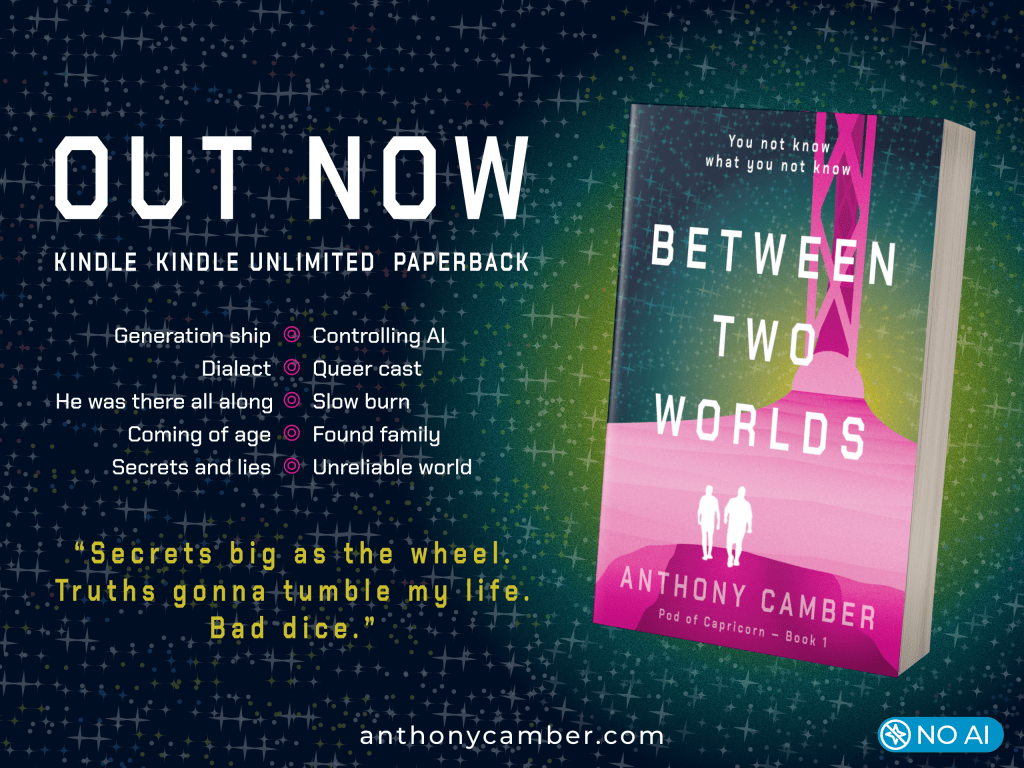
Between Two Worlds is available from September 1, 2026 for Kindle and Kindle Unlimited, and in paperback.
Preorder for Kindle: UK USA Canada Australia Germany France Spain Italy Netherlands Japan Brazil Mexico India
Add to your Goodreads TBR or StoryGraph TBR
Subscribe for FREE for chapter 1 and a bonus story:






Leave a Reply