
Book scams are on the rise. For once I’m not talking about the increase in the number of books on Amazon “written by” generative AI, though that’s a serious problem.
I’m referring to people — or maybe bots — who target indie authors on social media sites, enticing them with offers of support. Then, once the author’s snagged and dragged into DMs, the scammer presents the price list.
Like spam, these kinds of scams can be easy to spot. If you receive an email claiming to be from a celebrity interested in your book, or from an editor at one of the big five publishing companies, no they’re not. Especially if it’s from a gmail.com address.
Those are easy to ignore.
The bait is tastier on social media like Threads. The typical approach from the scammer is an engagement post, a dangling treat designed to lure authors who are scrambling to foil an algorithm that refuses to show their book posts to anyone.
Posts like these are very common in my (algorithmic) feed on Threads:
INDIE AUTHORS!!! NEED NEW BOOKS!! LEAVE YOUR BOOK HERE!!!
Sell me your book with the first line and the genre
Indies! Self-rec your book below with the cover. We’re always searching for hidden gems
To be clear: there are non-scammers who post things like this. They can be a great way to attract authors and gain followers. These genuine posters engage and empathise and have normal human-style conversations. I’ve replied to many, many posts like this to try to put my books in front of people’s faces.
And sometimes you hit a scammer. Part two of the scam is for the scammer to reply to your reply with a crooked finger, drawing you into more conversation. Here’s a reply I received recently:
This book goes well with my instagram audience. I am interested to review it. Dm please. Really excited.
If it sounds too good to be true, it generally is. And sure enough, the scammer had sent exactly the same response, character for character, to everyone who’d replied to their initial post.
I posted this thread:
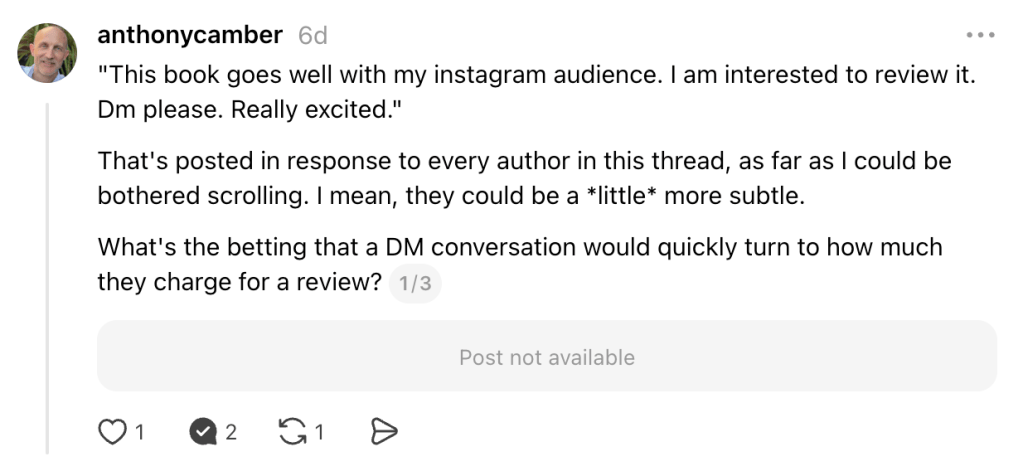
And the next morning, as I watched in real time:
- The scammer liked the post in which I called them out
- The scammer requested to send me a DM
- The scammer deleted their account (which is why their post isn’t available in the screenshot)
I never got to read the DM.
That exchange came after a few days in which I strung along another scammer. This person had been more subtle, and we’d exchanged a few replies publicly about my books and my process. Then came the inevitable request: let’s go to DMs and discuss this further.
Can you hear that klaxon?
I fired up Detective Google. The account was in the name of an apparently genuine author, Indie Black, and their Threads profile @indieblackauthor pointed to an Amazon page with books by that name. However, digging a centimetre deeper, it seems this author has been silent for a couple of years: their Goodreads page has comments asking where they’ve gone. I don’t know what happened and I don’t want to speculate. Neither do I want to imply that Indie Black, the genuine author, is a scammer. But the @indieblackauthor account purporting to be that author was deeply suspicious.
I hung a lampshade on it. I replied: “Are you going to try to sell me something?”
No, the account said, of course not. I replied “Ok, sure!” in full knowledge that this was likely the next step in the scam.
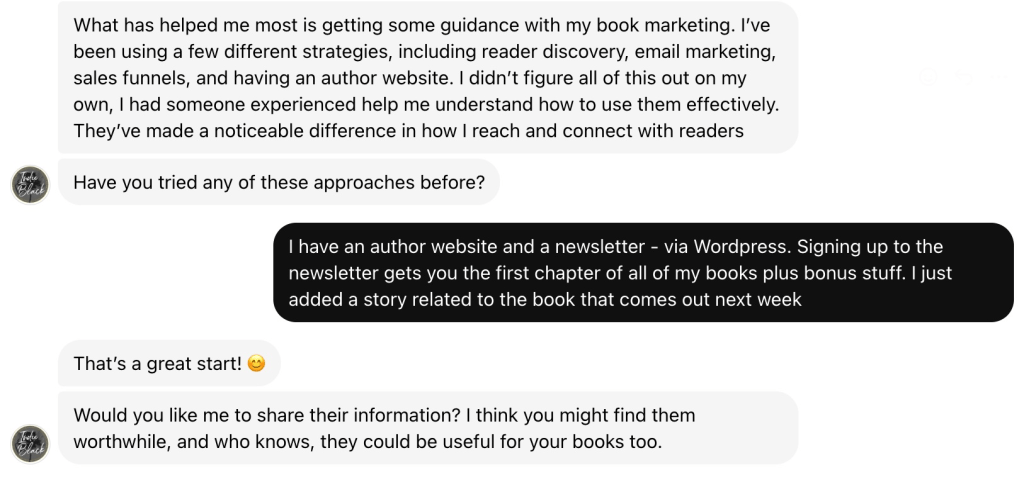
And so it turned out. Here’s some of the things they said in DMs, in screenshots. After the first image I knew my suspicions were correct. I gave them a chance to suggest something concrete but they pivoted back to the sell.
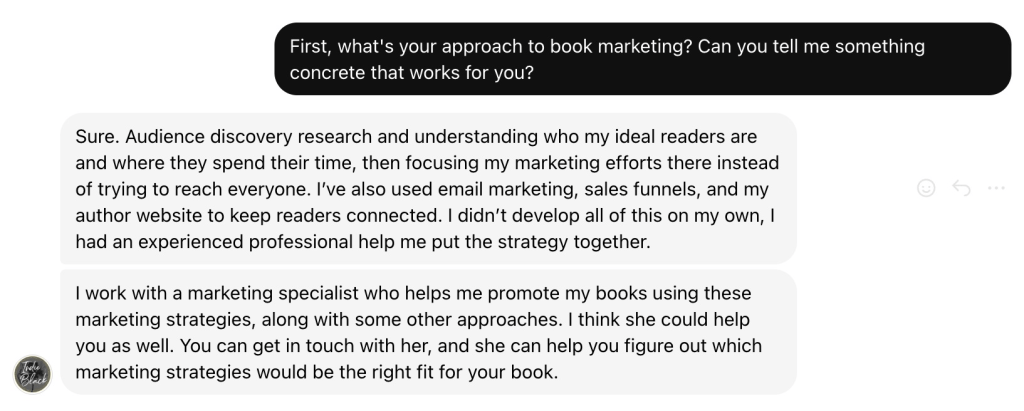
I then stopped talking and enjoyed the rest of the exchange.
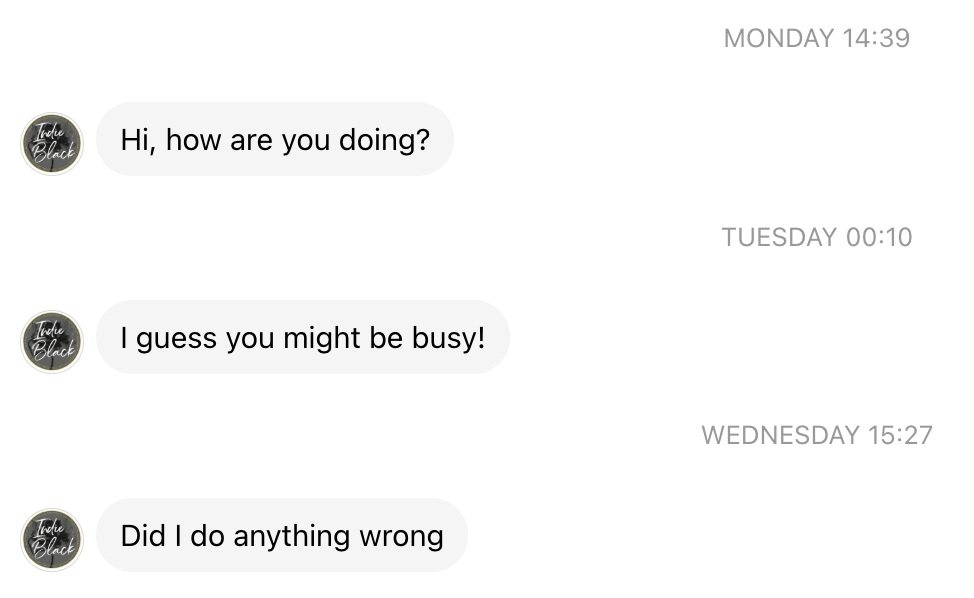
This scammer has now deleted their account. I still have access to the DM exchange. Of the public conversation, my replies exist while their posts vanished with the account.
You might think: this isn’t a scam, it’s someone trying to sell their editorial services and using somewhat underhand tactics to do so. I disagree. It’s a scam because of the deception. It’s a scam because the scammer will want me to email the person, about whom I know nothing, and then they have my email address and I still have nothing.
I’ve ignored many other scams. The “send me this post” scam on Instagram, for example, which is now lightly sprinkled with Zalgo text to evade detection. These scams are everywhere.
Scams proliferate because they work, and increasingly they’re automated using our old friend generative AI. Scammers can post bait in bulk to an audience of authors straining for visibility, their heads barely above an ocean of slop. Some percentage of those authors will take the bait and receive the switch, and some percentage of those will take it further still. Maybe that’s as simple as giving the scammer their email address, opening them up to wider scams. Maybe the scammer will present their price list for editorial services or reviews or whatever they were scamming for, and maybe the author will take them up. The funnel of the scammed narrows with each step, but some people likely drip out of the bottom.
If the cost of the scam is low enough — and it’s decreasing — then the scammers make a profit.
How do we fix it?
You can’t solve social problems using technology, and scamming is primarily a social problem.
But technology doesn’t get to wash its hands and walk away.
Social networks like Threads need to improve at detecting scammers and scams in progress. They should redirect more of their generative AI efforts and CPUs to targeted machine learning that focuses on scam identification and mitigation. If they’re not even pinging an issue when someone’s sending exactly the same reply to dozens of people, then I’d say there’s a lot of low-hanging fruit on which to chomp.
That’s assuming the social networks want to stop scams. That assumption might be incorrect.
Perhaps humans should abandon scambot-infested sites for pastures new, and let the scammers eat themselves. Ultimately that might be better for humanity.






Leave a Reply