
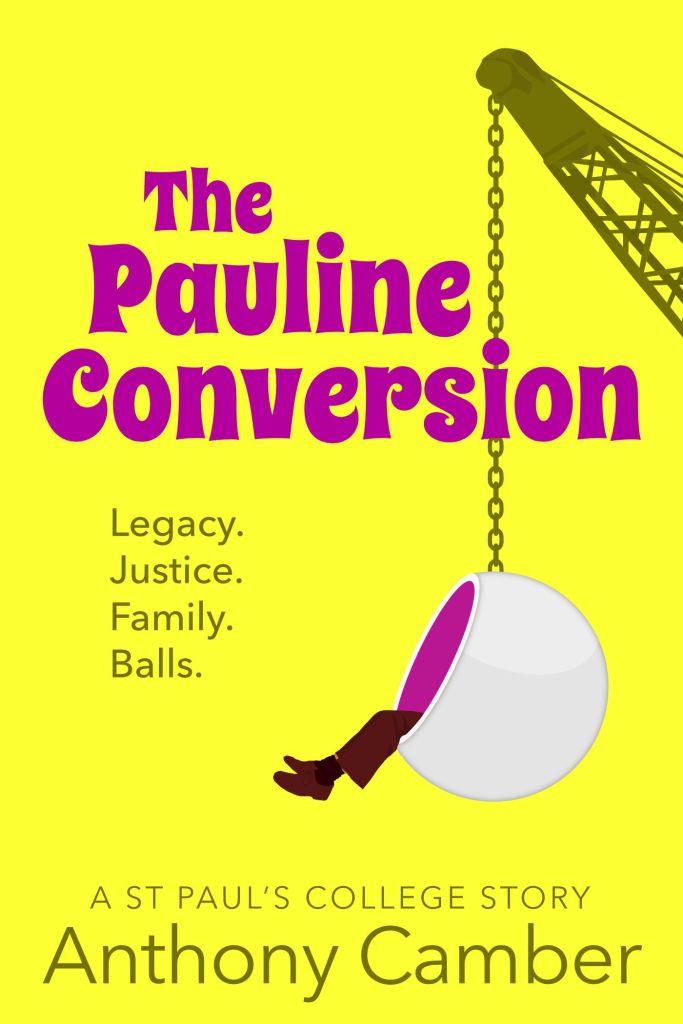
Here’s the full, unedited text of the first chapter.
For more, see the book page for The Pauline Conversion for all the links.
1. Bloody cheek
I soared skyward with my college gown flapping behind, like a bespectacled, balding Super-gentleman, and found the experience lacking a certain elegance. At the highest point on the arc, with the motor car that nudged me onto the ice steaming away without a care, my thoughts turned to the practicalities of landing. This would not be a controlled descent into cotton wool with a forward roll and cymbal crash to finish, marked out of ten by dour judges from beyond the iron curtain. It would be a contest with my bicycle, from which I had recently been liberated, to see which of us emerged worst. As the kerbstone came into focus — my spectacles landing at a different airfield — I had a microsecond to contemplate once again my utter absence of legacy before scraping my face across the tarmac to rest nose-down in a gutter sprinkled with iced leaves.
But some of us are looking at the stars, Oscar once said. I bloody wasn’t. I was looking for my spectacles — thankfully intact, against a dog-stained lamp post — and then looking for my handkerchief, and then looking at the Rorschach blots of blood it soaked from my cheek and wondering how long the adrenaline would defer the pain. No, I was not looking at Oscar’s bloody stars. Swearing at the stars, yes, as I lay shuddering against the kerb recovering my wind. I swore most vigorously and inventively, even as the stars faded into a winter morning on an otherwise silent street.
It was not the most auspicious start to a Monday. At least the leaves had cushioned my landing.
Rushed footsteps preceded a strangulated yelp as someone found a patch of black ice and narrowly avoided joining me at street level. “Careful,” I said, “this gutter only has room for one.”
“Are you OK?” Scuffed plimsolls skidded to a halt beside me. A lad, perhaps eighteen, bent over puffing steam. Hair shorter than the fashion: on the Beatles scale, somewhat before the sitar and substances. An old bruise on his jaw — or dirt. Hard to distinguish upside-down against battleship clouds. He did not appear the fighting type. For which, given my current vulnerability, I was glad.
I grunted, levering myself one-handed to a seated position with the hanky against my cheek. “No Olympic medal for me this year, I fear. Not this year. I do not suppose you caught his number plate?”
“I didn’t see anything, sorry, I just heard you effing and blinding. You need an ambulance?”
“Goodness, no. A hand is enough.” He pulled me to my feet, his grip cold and damp. I brushed crispy leaves from my jacket and pullover before they soaked through to the bone, and flapped the gown and straightened my tie. Injury was no excuse for dishevelment.
“You’ll need a plaster,” the boy said, pointing at my cheek. He wore a small hiking pack on his back. “Boots won’t be open yet, but if you bleed all over the door they sometimes take pity.”
“I am experienced with first aid matters. I will be fine, thank you.”
He noticed my gown. “College, eh? Which one?”
“I am a fellow,” I said, trying not to look at his bruise. “Each day of term I earn one grey hair, and another jumps for its life. I have been here a while, as you can see.”
He stared as if counting the wrinkles, then turned to my bicycle sprawled unconscious by the entrance to the Fountain pub. My satchel lay still wedged into the basket. “All a bit bent.” He kicked a helpless tyre.
I swallowed. “I should limp on. Thank you for your assistance.”
He grabbed the handlebars and pulled the bicycle vertical. Wheels out of alignment, handlebars skew-whiff, fractured ribs of wicker on the basket. “I’ll walk you there.”
“Please, no need. I can push it one-handed.”
“It’s no trouble. This thing won’t go in a straight line. Doesn’t look like it ever did.”
“I am quite capable, I assure you. You must have things to do.”
“Nope.”
The response concerned me. Early on a Monday everyone I knew of his age was wrapped in a double mummy of blankets. “And… why not?”
He shrugged, and pushed the bicycle approximately forward. I followed, lame in the right leg. “You do not know where I am going.”
“Probably the same direction you flew in.”
Impeccable logic. I managed a grin, and worried how he would react to my destination along the street in the pale dawn. Despite the city’s historically liberal attitude to such matters and the recent changes that decriminalised us, St Paul’s College and its members were hardly popular or universally welcomed. Not all who passed the Georgian and Victorian façades accepted us. The boy’s language, “bent” and “straight lines”, concerned me especially. Perhaps I overanalysed: or perhaps a policeman would pop out from the shadows and bop me with a truncheon on a trumped-up charge of importuning. Or the boy could be trade, commuting from King’s Cross to cross the queens.
At least if it were entrapment a ready-made alibi bled into cotton. I hobbled like a half-nibbled gazelle, the dull ache of the wound growing.
We approached Emmanuel College, its dirty sandstone front furtive behind towering trees.
“This one? Emmanuel, isn’t it?” he said.
“No, and yes, respectively.” Local trade? “Farther.”
“Christ’s? Or—” He waved, spooking the bicycle.
I could delay the revelation no longer. “I am not ashamed. I am a member of St Paul’s.”
“Oh.” No change in his expression.
“It is not the place of popular myth and legend. Simply— simply another college.”
“Queer’s College. That’s what they say. St Poof’s.”
“I have heard. I have heard them all. Perhaps you should give me the bicycle.” The cold seeped into the wound, the handkerchief made of ice.
The boy stopped. “Are you scared of me?”
“Not at all,” I said, forcing a smile. “If you believed everything said of St Paul’s, you might more likely be scared of me.”
“I’m not scared of anyone.” He walked on, the bicycle ticking beside him. “If I wanted to rob you, I’d have done that when you were in the gutter. Kick you in the… you-knows, easy.”
“We are grateful for your kindness.”
“You reckon the car hit you deliberately? Because of—” He gestured again to college.
“Occam’s razor suggests not.”
“Right.”
“The principle of fewest assumptions, in brief. William of—”
“I did it at school.”
I cancelled the lecture. He was unlikely to be trade — they were not particularly au fait with philosophical logic in my limited experience. But still, here was a boy on the dawn streets with no apparent purpose. “What would Occam make of you, I wonder?”
He treated the question rhetorically.
We crossed the side street bordering college. Here was the south-west corner of St Paul’s, a thick wedge of Georgian stone not quite ninety degrees, scuffed and chipped and scratched with obscenity down the generations. Inside college we knew it as Sharpy Edge, where a policeman would be posted to keep an eye on the goings and comings. The spot was marked by droppings of cigarette ends and a streak or two of boot polish on the pavement. Nobody on duty now: too early, too cold, and too many more worthwhile targets to guard in the fractious political climate. Striking miners dominated the news: some chap called Scargill making a name, and the curious Mr Heath unbudging.
“I’ve always walked on the opposite pavement,” the boy said, gesturing at the department store windows of Robert Sayle across the road.
“I thought you were not scared?”
He glanced at me. “Dad insisted.”
A few more steps to the college gate. I could press a little now, knowing which cry would bring the porter on duty scrambling to my rescue with his attack-umbrella. “And now?”
“I do what I want.”
“What does your father think about that?”
“I couldn’t give a shit.”
I nodded. We arrived at the gate, closed as always against the misunderstanding and disapproval of the Cambridge bustle. The pink and grey paint on the stone around the porch was speckled and peeled, awaiting a greater enlightenment. “Where do you go from here?” I asked with deliberate ambiguity.
He shrugged. The universal symbol of youth: evasion of all questions.
“I suggest somewhere warm.”
His expression told me this would be easier said than done. Behind me the observation slot in the gate slid open. I ignored it.
“Do you know Dot’s? The Dorothy Café?” A place not too distant: struggling on past its prime but still serving a band of regulars. Allowing the intensity of the cold to batter my wound for a second, I slipped two pound notes from my wallet and offered them.
“I can’t.”
“You assisted me in a time of need, and now I want to assist you. There is no obligation. You are a fine young gentleman in a pickle. It is not intended as a— as a down payment, if that concerns you.”
He stared at me, and the notes.
“Please.”
He gave in, and mumbled thanks.
“And— And I shall be along later for a spot of lunch. I expect to see you wrapped around a mug of tea, digesting a hearty breakfast.” I had not planned to visit Dot’s that day. It seemed right, though, as a way to convince the boy. I held out my hand to shake. “Dennis.”
He hesitated as if scared to touch me, then shook. Still a palm of ice, a wrist thin and weak.
“And your name?” I asked.
“Red,” he said, with a grin.
As the boy crossed the road, the door set into the college front gate swung open, hinges squealing against the oak.
“Come in if you’re coming,” Arthur said.
I dragged my machine with me over the threshold — it was never wise to disobey a porter. He shut and bolted the door in a practised move. Wearing gloves and a balaclava — under a bowler hat — Arthur put me in mind of a terrorist banker.
“It’s not my place, I know.” His eyes drifted to the bloody handkerchief.
“The twin fists of frost and tarmac.” The cold numbed my jaw and I may have said “frists of fost”. I leaned the bike against the porters’ lodge and levered out my satchel with hand and elbow.
“And the boy?”
“I presume you heard our exchange.”
“Heard and saw. Look—”
“He was not— he wasn’t trade, if that’s what you’re skirting around. I am not exactly—” I left it dangling. I was not the type: he knew this.
“Don’t get taken for a ride. That’s all I’m saying.”
“The boy hardly engineered my fall. That would have been worth more than two pounds. This was no Great Brain Robbery.”
Arthur let the moment pass, venting steam and a trace of his last cigarette. “That hanky’s like a butcher’s apron. Let’s see the damage.”
I batted him away. “I’m fine, I’m fine, don’t fuss. It is a graze, no more. I do not need drizzling in antiseptic.”
“You should clean it as soon as—”
“Yes, thank you.” I cut him short, dabbing and wiping gritty blood from the side of my face. Then a freezing fog of guilt enveloped me. “I appreciate your attention, I truly do.”
The porter nodded. I liked Arthur: he seemed popular with the students, being of a similar age and swishiness, and we in the fellowship found him efficient and courteous. Friendly, even. He had joined St Paul’s at the turn of the decade — given five or six years more, he might become a permanent addition.
“I am becoming too old for bicycles,” I said, filling the silence. “I spotted a drain and attempted to curve around it, and then a motor car under the dubious control of some hairy clown nudged me on top of it. A townie, I shouldn’t wonder — or one of those laying waste to Cambridge in the name of progress. Someone after some sport with a gentleman of the university.”
“I’ve told you, don’t wear the gown.”
“I have been wearing this gown, and its illustrious predecessors, for—”
“Yeah, I know all that. Just— be careful.” He imbued the words with clouds of broiling doom.
“Have you ever known me to be reckless?”
“You just gave a boy money on the street right by the gate. And told him you’d meet him for lunch.”
This, I conceded, mutely.
“And, Christ, was sharpy on?” He jabbed toward the blackboard fixed to the stone wall opposite the lodge, with its ever-present stick of chalk resting on top and a grubby cloth hanging from a hook. On the board, words neatly painted in white: “Sharpie is ON / OFF”, with “OFF” currently circled. (College had never quite settled on “sharpy” versus “sharpie”. The latter seemed too… French for my tastes.)
I reassured Arthur of sharpy’s absence, and my lack of naïvety in such matters.
“What about this car, then?” he asked, on firmer ground. “What make was it? Did you see the number plate?”
I pushed up my spectacles. “I sadly lacked the wherewithal, gliding heavenward, to note down his particulars. It was a mock Tudor vehicle, I believe. Half-timbered panels.”
Motor cars were not my forte. Like most in the university I could travel everywhere I needed to be on my trusty bicycle, a sit-up-and-beg now more of a lie-down-and-croak.
“I wonder, could you, uh…?” I waved at the machine as if casting a spell. I hoped he might persuade one of the more mechanical lads on staff to bash away at it with a spanner or chisel or whatever it required to teach it straight lines again.
Arthur stared at it, not moving from his station. “There’s nothing much I can do right now, is there?”
“I could wheel it into the back room for you.” I gestured into the orange glow of the lodge, recently refurbished with a small forest of pine. All it needed now were hot coals and a bucket of water to become a fine sauna.
“Leave it where it is. If you got oil everywhere his nibs would give me one of his looks.”
His nibs being Selwyn, the Head Porter: Arthur’s boss. “I am sure he would be utterly reasonable about it.”
“Right up until he drew blood. Are you still gushing?”
It seemed the bleeding had stopped. Tentative prodding suggested only a raw skid mark remained, tingling in the chill with the promise of pain later. I thought better of wiping my spectacles with the hanky and stuffed it into an inside pocket.
The agreed knock at the gate and Arthur’s facial contortions told me rush hour in college approached.
“Remember to clean the wound,” he said, meaning clear off. I hurried across the silver-tipped grass of Bottom Court, leaving a slug trail of defrosted green in my wake.
In my room on F staircase — strictly my office, as I kept a flat in town — I proceeded directly to my micro-kitchenette. In its entirety this comprised a sink and a shelf, with three poorly grouted once-white tiles and a patch of Formica that overflowed with two army surplus mugs and a spoon. Hands on hips, I shouted obscenities at the hot tap until it dribbled water tepid enough to wash the wound. Cleaned up it seemed a glorified paper cut, bite worse than bark.
Like the Head Porter I had been granted a dispensary by the Bursar for refurbishment — the post-war furniture buckling too often under the excess baggage of the modern undergraduate. The money, however, did not extend to functional plumbing. My redecoration introduced the bright oranges and rich browns of contemporary fashion, and a marvellous centrepiece: a chair suspended from the ceiling, a near-sphere of glossy white plastic lined inside with pink fur. I had craved it at first sight amongst the leather in Robert Sayle’s furniture department, not knowing entirely why. It was quite the talk of college after its installation the previous term, visitors standing mouths agape in awe. I was desperately proud of it.
The morning’s work dragged, accompanied by the mosquito whine of my injury. Through the window overlooking Bottom Court towards the lodge the usual entrances and exits played out, incoming and outgoing tides distorted in the ancient panes of glass. The dawn chorus began: muffled music thumped from another floor, discordant with a tinny warble across court. I recognised My Sweet Lord and Brown Sugar and other sucrose. Students clumped together, hairy cells wondering when to divide — unlike the miners picketing elsewhere in Britain, who had only conquest on their minds.
I did my best to save energy by switching off my electric fire, though the additional kettle activity offset any reduction. My conscience was clear, in any case, and my bladder truly flushed.
As the college clock struck noon, Yankee Doodle echoing wanly across the three courts of St Paul’s, I set aside the essay I was marking — an undergraduate’s thousand-word ramble across the blustery escarpment of truth — and left for my rendezvous at the Dorothy with Red.
Beyond the college ramparts Cambridge felt prewar. Townsfolk scurried between shops hunting for candles or oil lamps to keep darkness at bay come the power cuts. Speculation on the wireless concerned enforced three-day working weeks: one day more than most students, in my experience. Cuts be damned, Eaden Lilley’s windows were stuffed with nautical mannequins in a panorama of Dacron.
The Dorothy was busy for a Monday lunchtime and smelled of lavender and scones. I worried Red had been eased out on his ear to make room for housewives hauling a hundredweight of emergency wax. I located him in a far corner, mug of tea as instructed, his face less pale. Not a picture of contentment, and yet an improvement. He offered me a fractional wave, as if bidding at an auction.
We made small talk while I attracted the eye of the waiter. In the wars of town versus gown, this young man favoured those outside academia. He nipped across the black-and-white tiles serving maiden aunts and wide-eyed American youths geeing and bellowing before finding his way through the maze to our lace tablecloth. Blaming shortages, he regretted to announce most items were sold out. He allowed me either a cheese or a ham sandwich, but not both together: that would constitute an extravagance and be unfair to other patrons. He consented to provide me a pot of tea, and Red a sliver of Victoria sponge.
I wiped my spectacles on an emergency handkerchief. “I must say you look significantly more human. Tea works miracles. Absolute miracles.”
“Hasn’t reached my toes yet. My socks are too thin.”
“Easily resolved. A gentleman in Men’s Wear at Joshua Taylor is known to me. He will find you the warmest in stock.”
“I only have the money you gave me, what’s left of it.”
I did not miss a beat. “I have an account there.”
“I can’t— you bought me breakfast. I’m not—”
“As I said, there is no obligation. I am repaying a favour.”
“I didn’t realise favours were that expensive.”
My tea arrived, with spillage, together with Red’s cake and in concert with a hubbub from the Americans — comrades lucky or rich enough to have escaped the quagmire in south-east Asia, or absconders deserting for dessert at the Dorothy. Even I had not dared run away from national service, though I slotted between World War Two and Korea and never saw action. No action whatsoever. Navy, obviously.
The waiter assured me my sandwich was in a queue, although it was touch-and-go whether it would contain any cheese at all.
Red’s sponge went down very easily. The sandwich, when it arrived, had cheese but lacked a certain something, an act of great skill with so few ingredients. On this visit no unexpected ingredients had been included.
“If I might be blunt,” I said, “where is your family?”
“I don’t give a shit.”
I expected that response. “Would you like to tell me what happened?”
“You don’t want to know.”
“I might know already.”
“How could you?”
“Think of St—” I lowered my voice, and scanned the café for fat ears. “Think of my college. Its reputation. We are not unfamiliar with the displeasure of parents. Despite a shift in law, a significant shift in society has yet to emerge. Many boys still arrive with fresh bruises like yours, all their worldlies on their backs. The stigma remains. It takes a while to fade. For some it never does. It never does.”
He said nothing.
“You are no idiot,” I said. “You have an education, prospects. And yet you walk the streets, apparently disowned. That is no state to be in at your age. At any age. And with thin socks in February, for goodness’ sake. Where— where do you even sleep?”
The boy shrugged. “I don’t need any help.”
“Your resourcefulness is not in doubt. You had the wit to invent a name when I asked. You are not Red, that is evident. Rhett, perhaps? Did your parents meet at a showing of Gone With the Wind? They will want to know you are safe and well.”
“Yeah, ’cause that’s why they—” Kicked me out, he didn’t say.
“At least tell me you have a roof over your head at night. This is no weather for stargazing.”
Red stared at the Americans joking with china tea cups. “I have somewhere.”
I kept silent.
“The car park. The new one. There’s a hole in the fence.”
“The building site?” Part of the new Cambridge being foisted upon us, a several-storey shrine to the motor car.
“I have a cosy corner. Underground. It’s not warm, but…”
Better than nothing. It was the first time I had a good word for that folly.
He would not divulge his real name, nor his family’s address, and changed the subject whenever I broached the idea of accompanying him home or telephoning. He would take neither my money nor my socks. He simply gazed at the Americans, perhaps like him free but not free, with what seemed at first a longing, and then unless my eyes deceived, a lust.
It was a look familiar at St Paul’s, aimed most often between the boys — and occasionally from boy to porter or to fellow, a look strongly discouraged. It bolstered the hypothesis I had formed for Red’s predicament: he was queer, like all of us at college, discarded like an unwanted puppy on Boxing Day. And he was alone.
Want to read on?
See the book page for The Pauline Conversion for all the links.



 Anthony Camber