
In my post Discovering Unstable Orbits I mentioned the broad themes of the book — second chances, mental health, parenting, friendships and love — and how they were magically revealed to me only after completing the first draft. This is when writer becomes reader and discovers, often to their surprise, exactly what they’ve written.
For this post I want to concentrate on one of those themes: parenting. I didn’t write Unstable Orbits with this theme in mind, and I didn’t expect to find it lurking in the text. But there it was, grinning at me, as I sat blinking into the sunlight.
Why was it a surprise to me?
Many YA novels include the parents of the main characters, and often they’re key to the underlying story, driving the plot. With queer YA, sometimes one or both parents are religious and anti-LGBTQIA+. Or there’s a divorce in progress. Or there’s a struggle with dependency. Or one’s absent, or controlling. Or they’re relentlessly positive.
But I didn’t want to include any of those tropes in Unstable Orbits. I didn’t want the parents to sit and listen and hug things out. I didn’t want honeyed scenes in kitchens the size of Venezuela with parents dispensing grown-up wisdom over a breakfast banquet. I didn’t want parents to appear in the book at all.
That’s why Unstable Orbits tells you almost nothing about Nate’s parents, and we never encounter them in a scene. There’s no direct reported speech from them. Everything is one step removed, through Nate. We learn a lot about Nate’s view of his parents, and the other main characters’ views of their own parents.
I think that makes the book far more interesting, and different.
And it made the realisation that the book was nevertheless at least partially about parenting more of a shock and a revelation to me.
It’s not, primarily, about the parenting done by parents.
In the UK, we as a society send our kids to school for six hours a day, five days a week, about 39 weeks a year, for up to 13 years. Teachers and their assistants, and other school staff such as librarians, kitchen/canteen workers, nurses, caretakers and administrators, spend vast amounts of time parenting those kids.
There’s a reason kids sometimes call their teachers Mum. I did so once (in St Albans Cathedral on a school trip aged 13; you never forget).
In Unstable Orbits, we don’t see any teaching in Ebeham High School, but we do see parenting. We don’t see any book sales in the Ebeham Bookshop where Nate works, but we do see parenting — from Roscoe, the shop’s owner.
These surrogate parents are staggeringly important to society, and ridiculously undervalued by it.
For a long time I didn’t know what the dedication for Unstable Orbits would be. At this revelation, it became obvious: For those who parent but aren’t parents.
In the Acknowledgements at the back of the book I mention some of my own teachers. Forty years on, I still think about their kindness and generosity.
I want particularly to call out Mr Stern — Harry Stern. Technically, Commander Henry Stern CBE. He’d been in the Royal Navy during World War II and saw action above deck and in submarines. He spoke Russian and was sent by the Admiralty to serve as Russian Military Liaison at GCHQ. Teaching Maths was his second career, and his passion.
For family reasons I moved schools aged 14, and went from a non-streamed school — all kids together, regardless of ability — to a streamed school, teaching according to need. In my previous school I’d been good at Maths but held back by the requirement to move at a slower pace for the less able in the class. Consequently I was frustrated and bored.
I remember discussions taking place at the new school: which Maths class should I join? The top set or… not? Ultimately the school, and Mr Stern, took a chance on me and placed me with the higher achievers.
I struggled. The class had already been taught trigonometry — but I hadn’t. I had no idea about sines, cosines, tangents, and SOHCAHTOA. Within the first couple of weeks I sat my first test, and it was a disaster. I managed, somehow, 34%. I was ashamed. It was the lowest test result I’d ever had in the subject.
The school could have moved me to a lower set. But Mr Stern simply told me not to worry, that he’d catch me up. He had faith in me. He taught me trig, and the mnemonic he used: Silly Old Harry Caught A Hot Tomato Over Algeria. When I need to use trigonometry (yes, sometimes I do!) that mnemonic still jumps into my head.
By the end of that school year I was at or near the top of the class. I stayed there for the rest of my time at school. That was in no small part because of Harry Stern.
He died in 2021, aged 97. I’ll always regret not getting in touch to thank him.
Here’s how he looked in the Navy, and how I remember him from school, except in lower resolution:
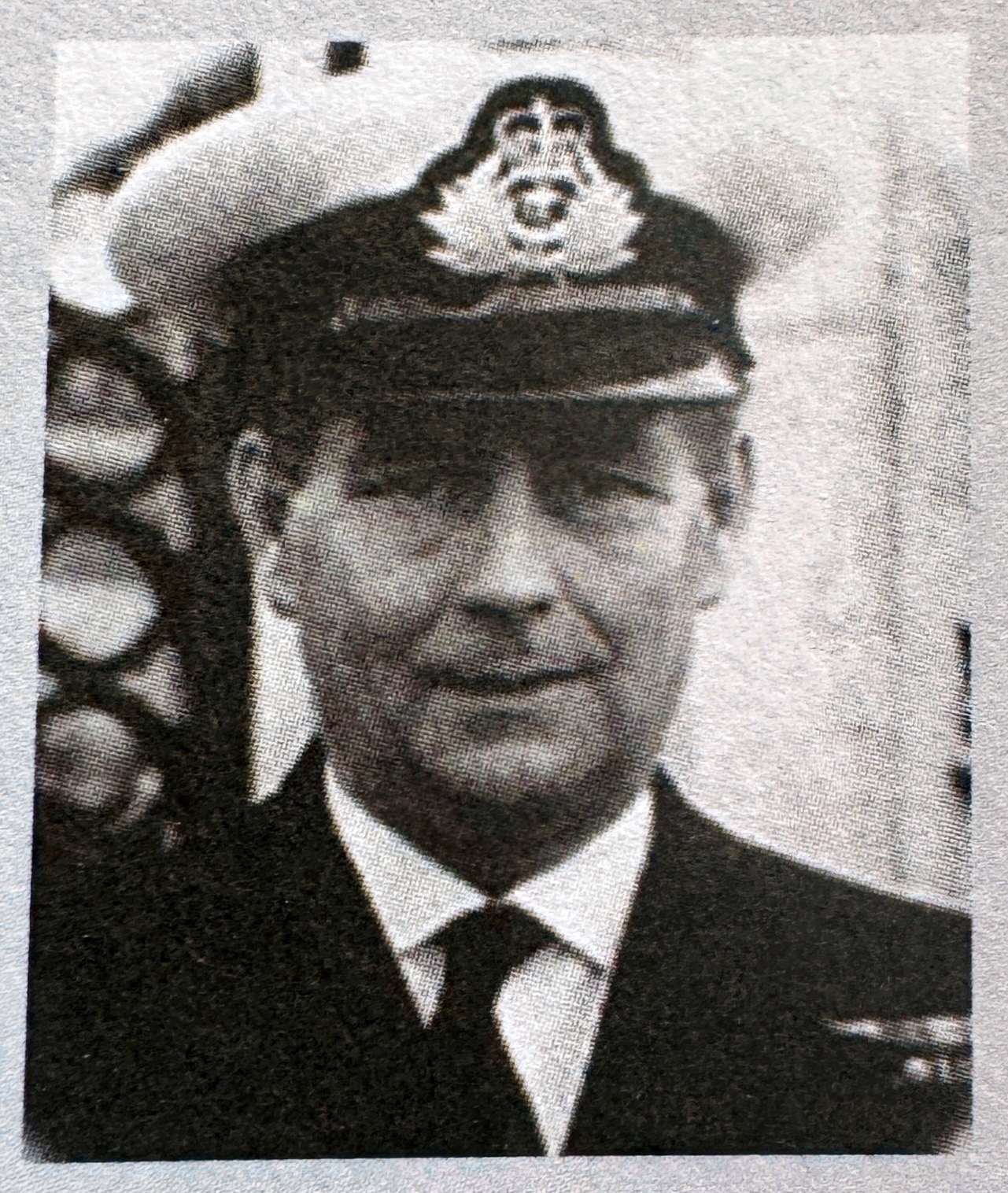

He wasn’t my parent, but he parented me (and hundreds of other kids) in his teaching career, and I’ll forever be grateful to him for that.
And that’s why Unstable Orbits is dedicated to people like him.



 Anthony Camber