

Books have wildly different origin stories. Till Undeath Do Us Part started with the title. Disunited started with the urgent feeling that a top footballer was about to come out (spoiler: nope). A Room Full of Elephants started with an odd vision of an elephant stuck in a bathroom wall.
What about Unstable Orbits?
Picture it…
It was 2021. The world was reopening, masked up. I was sitting in coffee shops again and feeling the urge to write. Not to outline, but to write. I knew it would be Young Adult: I’d been itching to write some YA for a while. But what was the story?
In these situations I think of a vague concept and let my fingers wander. Here, I started toying with the concept of “off by one” — any engineers reading this will know what I mean. (How many numbers are there from 3 to 8? Naively you subtract 3 from 8 to get 5, but the answer’s 6 — 3, 4, 5, 6, 7, 8. It’s very easy to be off by one. It’s a common software bug.)
This thought sparked the idea of a student repeating Year 13 at school, and consequently being “off by one” year going to university. Noodling around with some prose brought the idea of a small town with a fountain where school kids meet (which appears in the book once or twice), and a bookshop where someone works, and a (non-white) boy from the new Year 13 who’d be part of the story. I also started thinking about a quarry, an idea which persisted for a while (there was going to be an incident there, relevant in ways I never quite figured).
The fountain was going to be a place of strict teenage hierarchies, but that idea didn’t persist either. I wrote one short noodling scene of that, before anything else, before anyone had a name, before there was a plot. I thought it might be fun to post it here. Consider this a bonus irrelevant short story about a fountain… it’s completely unedited, transcribed from my handwriting.
Stepping up
“Do we just… sit there?” I said. “Stroll up, grunt, and park on the top step?”
BBB rubbed his mouth. “I guess?”
I kicked at a pebble as we approached the fountain. It skittered under the back wheel of a sprawling bike, pinging against a spoke. “Oi,” said a second-step kid. He’d change his tune when we assumed our rightful place. Oh yes. And not only the top step — the prime slots, out of splash range, and exactly where the pair of cherubs were pointing. The places anointed by a sculptor, some Victorian chancer who’d be arrested now but in the olden days he could chisel away at a kid’s bits as long as he gave him wings. The steps that belonged, by custom and practice, to the oldest, coolest kids in town. Around which the younger, warmer kids congregated, awaiting our wisdom and gifts, praising our fashion, our jokes, and in some dreams offering favours of a very particular kind.
“Shift,” I said to the girls currently sitting there, both of them sharing a single eyebrow.
“Didn’t you leave?” said one.
“Change of plan,” I said, gesturing. A scoot-along signal, fingertips twitching to the left. “Retakes.”
“Retakes don’t count,” said the girl.
“Says who. Shift.”
Reader, I would not have said this to a pair of boys. My tongue would have ballooned, my saliva scorched to desert, my voice straddling octaves. For girls, though — no problem.
“Yeah, no.” She gave me a head tilt and a fake smile.
The idea
Immediately after that sketch of a scene — I’m a geek, and I dated it — on 6 August 2021, came this:
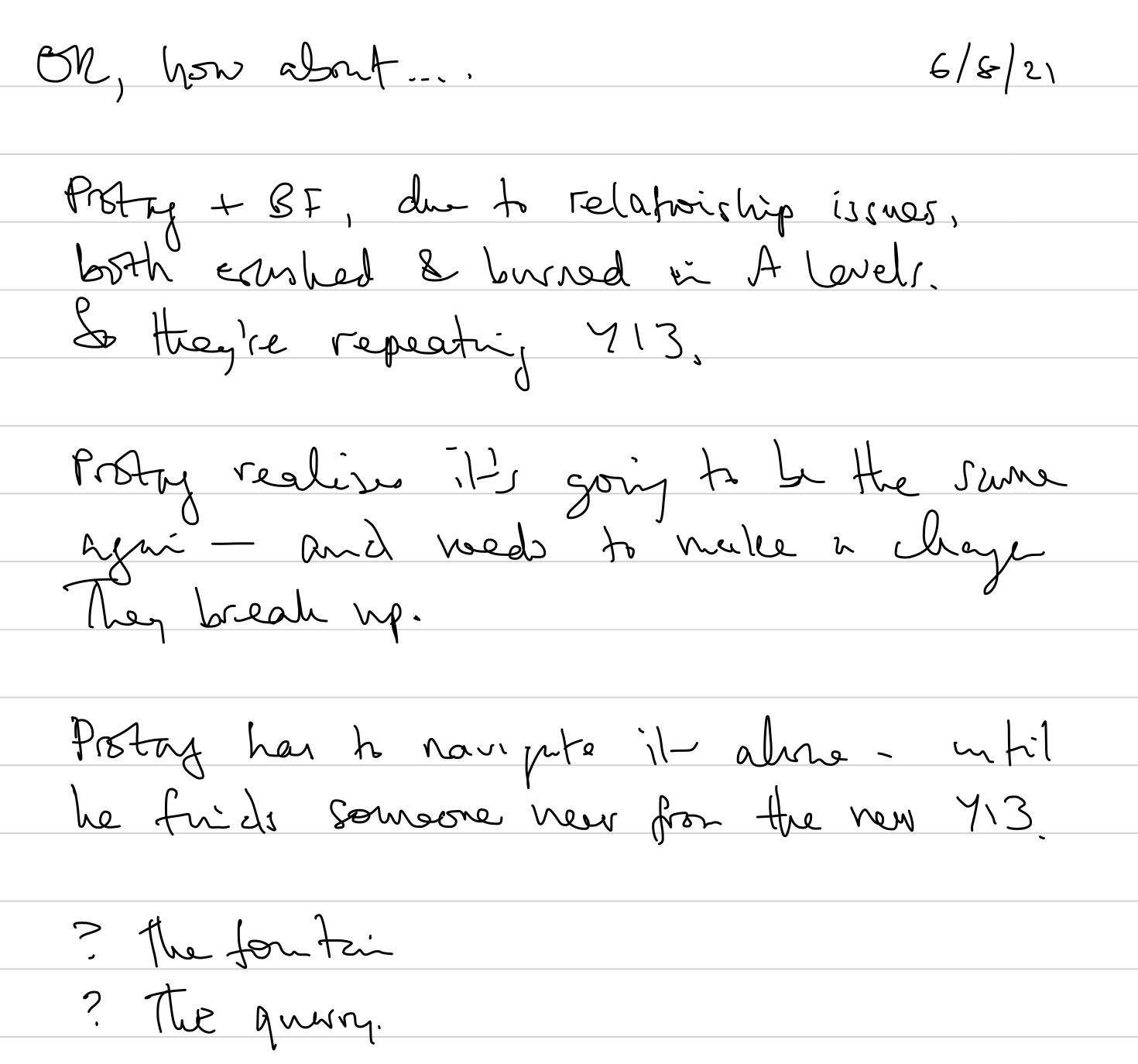
You can see the bones of the story there — including my uncertainty about the importance of the fountain and the quarry.
Now I had a concrete idea, the “off by one” theme faded. But I still felt I needed a big picture to help guide the writing without making me write an outline (because I was only writing this for fun). Somehow I latched onto Newton’s laws of motion — I don’t seem to have a record of when that happened.
The thought was: it could be a three-part story, with each part broadly based on a law of motion. Part 1 would be about inertia; part 2 about force; part 3 about reaction. It’s why the protagonist of Unstable Orbits is called Nate: Nathan being a bit like Newton. I toyed with the idea of the book’s title being Nathan’s Laws of Emotion for a while, and this gave Nate two of his major traits: his strong emotions, and his tendency to see the world through Physics.
Of course, plans never survive contact with the enemy, and those three parts didn’t materialise. You can see elements of inertia throughout part 1 of the finished book, but that’s about it. There’s a part 2, but no part 3.
Themes
Inciting themes like “off by one” and Newton’s laws are tools to help writers out of their heads and onto the page. It doesn’t matter that they evaporate. Indeed it’s often better that they do, otherwise you feel you have to shoehorn the idea everywhere (“OK, so what’s the off-by-one in this scene?”).
The actual themes of a completed book are very different. They emerge only after the first draft is complete, through a combination of small and large revelations obtained on long walks and under hot showers.
Unstable Orbits is about second chances, and mental health, and parenting, and friendships, and love.
Part of the joy of writing is discovering what you’ve written. In that sense it’s like raising a child. A book grows and gains a character, a definition, as you mould and shape it and chisel away at the rough edges. That’s the hard slog of draft after draft.
Releasing a book is like your child going to university: it’s out in the world now, living its own life. It’s no longer yours. Except it still wants money (promotion) and returns regularly with a bag of dirty washing (newly discovered typos).
And it feels like a loss, too. A hole in your life.
And so you move on to the next one.
Preorders and ARC requests
Don’t forget you can preorder Unstable Orbits for Kindle right now. The book page has all the links. I’ve added some content notes too, listing some topics the book covers.
If you’re a regular book reviewer, and you post your reviews to Amazon and/or Goodreads or somewhere else with many readers, I’d love to offer you the chance to receive an ARC of Unstable Orbits ahead of release, completely free — in return for an honest review. Sign up at https://forms.gle/x1ws2uWrwohxMjL39. ARCs will be distributed in epub format in early June.



 Anthony Camber