
As you might have gathered from my last two posts, I’ve been reading more than writing for the last couple of years. So far 2024’s tally is outpacing 2023 by some margin: I’ve just started reading book 48 of the year, which matches my total for the whole of 2023.
In this post I want to talk about book 47: Road Song: Step One by Samuel Lediard.
First I want to give Samuel credit. The two hardest parts of writing a book are (a) starting and (b) finishing, and Samuel achieved both. He (apologies if Samuel uses other pronouns) had an idea, knuckled down, wrote to the end, and finished the story. This is trickier than it sounds. For The Pauline Conversion I wrote on average about 1200 words a day for 90 consecutive days to complete my first draft (I have a spreadsheet to prove it, because I’m a nerd). This is a slog. And meanwhile life goes on: working, cooking, travelling, eating, sleeping. Finishing is an achievement: both crossing the line, and understanding where the line is (some books go on too long).
But a first draft isn’t a finished book, and sadly Road Song: Step One reads more like a first draft. I don’t think Samuel should have released it in its current state. In my one-post review on Threads, I awarded the book 1 out of 5: half a mark for finishing, and half a mark for giving the main character, Blue, a stammer.
Samuel’s book contains a significant number of issues. I don’t want to use this post to dump on him from a great height – I’m hardly the greatest writer in the world. Instead, I want to educate. Using extracts from Samuel’s book (I’ll reference it as RSSO), I want to illustrate some problems and how I would address them. I’ll focus on technical concerns, not plot and character (there are issues there too).
Tense
Writers have a choice: present tense or past tense. Some like to use the present tense for its immediacy and its ability to increase tension – present tense can make a book feel like a movie. Some prefer the past tense, as it’s the more traditional way stories have always been told and it can feel more reflective.
It’s possible to mix the two, carefully: in Till Undeath Do Us Part I used present tense for scenes set during the zombie rampage, and past tense for the history of Josh and Olly’s relationship.
Now look at these paragraphs in RSSO:

Notice the verbs: shot [up], sparkled, and then breezes, responds. The writing has changed tense mid-scene. New writers often do this, and RSSO constantly switches between tenses – sometimes within the same paragraph. It’s dislocating for readers.
The advice here is simple: pick a tense. In this case, Samuel started with past tense and that’s a reasonable choice – so the words should change to breezed and responded.
Perspective
The choice here is between first person, third person omniscient, and third person limited.
- First person puts you directly inside the head of a character. You see and experience everything from their perspective, and they narrate the story. You can change that character from time to time – typically between chapters – but never within a scene.
- Third person omniscient is “god view”: the narrator can see inside everyone’s heads and switch focus between them, visit locations without any characters present, and so on. You can think of the narrator here as another character nobody in the book is aware of except the reader.
- Third person limited ties the narrator to a single character at a time, viewing the events of the book from their perspective only. The character can change, typically between chapters or scenes.
In RSSO, the author’s using third person omniscient but – in the words of Nathan Bransford – is head jumping. Here’s an example:

In the first paragraph, we’re inside Harry’s head – Harry is sensing, Harry is trying. In the second paragraph, we’re inside Peter’s head – Peter is agreeing, Peter is eager. We’re skipping between heads, and readers can find this disorientating if it happens too often and without proper signposting.
My advice here: we see most of the novel from Blue’s perspective, and I think it would benefit from being entirely from Blue’s perspective: third person limited, or even first person. I’d be tempted to use first person, as that gives an autobiographical feel that would suit this story: it’s about how Blue turned several corners in his life. That change would mean rewriting some scenes in which Blue doesn’t appear.
Show, don’t tell
The classic piece of advice. Let’s look at that last example again:
This is full of telling. We’re told that Harry is sensing, is redirecting. We’re told that Peter is in agreement, is eager. It’s better to show this. Let the reader figure out the meaning. It’s easier to get this right with a first person perspective: the narrator doesn’t know and can’t say why Harry and Peter are doing what they’re doing, only what they’re doing. Show the reader that, so they can infer the reasoning.
Here’s one way to rewrite those paragraphs:
Harry held up his hands between them. His voice was tight. “Look, can we just–? How about we find a quieter spot? We need to plan out tomorrow morning.”
Peter nodded rapidly. “Oh god yes please.”
Here, without digging into Harry or Peter’s head, we have a good idea how they feel from how we see them act, and what they say. There are fewer words – which makes it easier to read. Unlike the original, the conversation isn’t broken up after every speech by a sentence of prose – which improves the flow.
In RSSO, showing instead of telling might halve the size of the book. There’s a lot of telling. Almost every piece of quoted speech is accompanied by a prose description of the speaker’s intent.
Showing enables subtext, and subtext is an ingredient in the special sauce that brings characters to life. Let’s look at another example from the book:
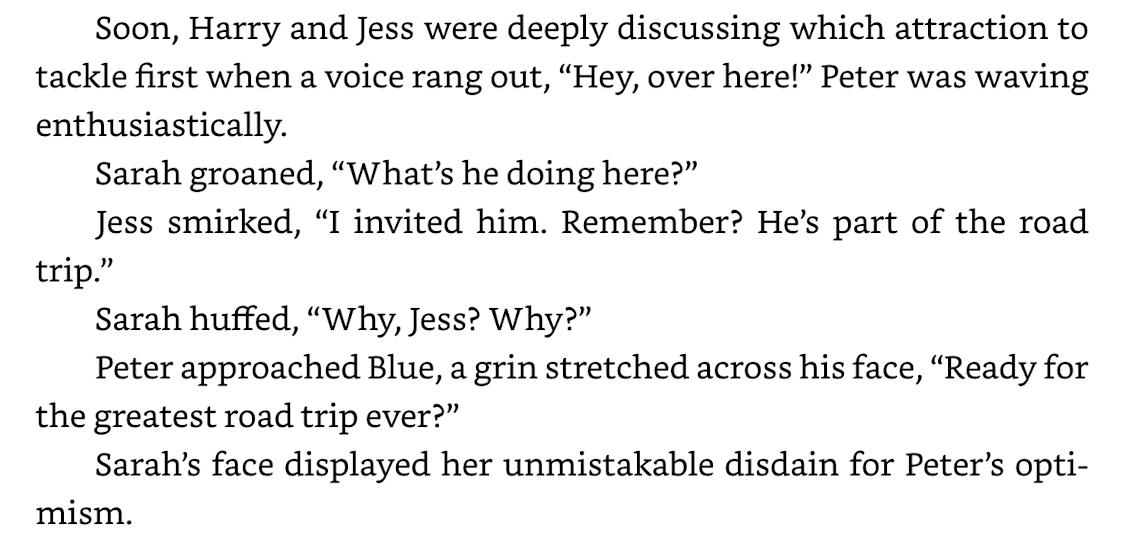
Sarah hates Peter: we’re told that repeatedly. Earlier in the book we learned that Peter likes Sarah very much. Let’s take out all this telling and do some showing, and squeak open the subtext taps.
Soon, Harry and Jess were conspiring in whispers. Then a voice rang out: “Hey, over here!”
Sarah groaned, rolling her eyes. Jess looked up and smirked. “Did you forget?”
“I hoped you had.”
Peter bounded over to Blue, grin as wide as the ferris wheel, gaze never leaving Sarah. “Ready for the greatest road trip ever?”
Sarah turned away, eyes making daggers at Jess.
In this version, we know Sarah’s feelings for Peter, and Peter’s feelings for Sarah – without it being spelled out. Jess, Sarah, and Peter all gained a little depth, a little life.
Repetition
New writers often repeat words too frequently. Readers spot this repetition, and it jars. Here’s an example from RSSO:
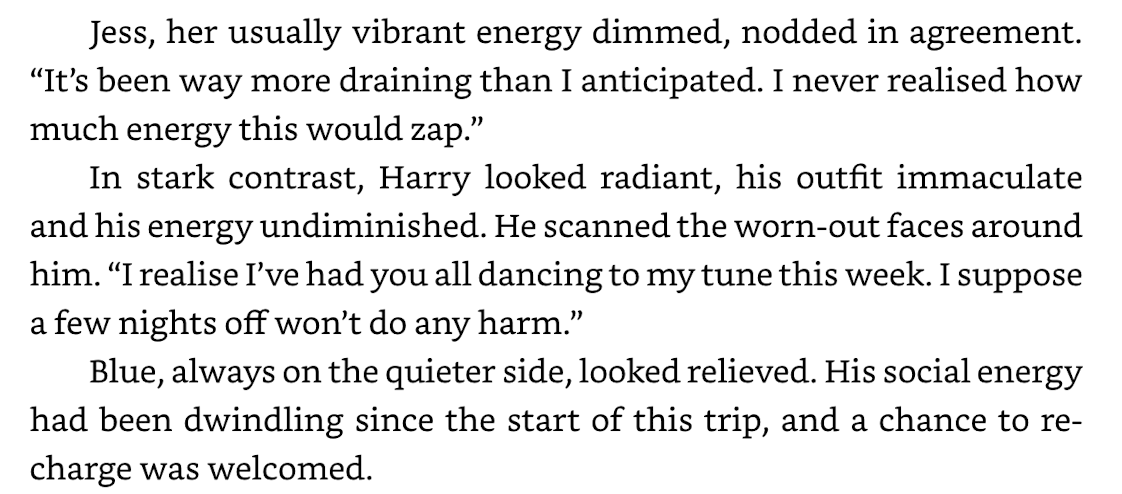
The word “energy” is used four times in three paragraphs. In this case, showing not telling would help. Alternatively, the author could choose different words, or cut some lines. Does Jess’s second sentence add value? Perhaps work in a simile or metaphor around a battery? “He’d been running on empty”.
Sometimes repetition is deliberate, for effect – this is fine.
He said, she said
Authors sometimes see the advice to avoid too frequent repetition and try to apply it too broadly. They see the word “said” or “says” (depending on tense) appearing everywhere and decide they need to change them. This leads to ever more exotic verbs like “offered”, “remarked”, “interjected”, and “countered”. RSSO uses those and more.
The advice here: use “said”, “asked”, and that’s about it. Perhaps a more interesting verb occasionally, matching the emotions: “cried”, “whispered”.
The simplest, most common verbs like “say”, “ask”, “go”, “have”, and “is”, plus pronouns, “and”, and “the”, and similar words, are almost invisible to us when reading. They don’t trigger the repetition klaxon in our heads.
Read aloud
All the problems above are easier to spot if you read your writing aloud. Placing your voice between your “reading brain” and your “understanding brain” seems to introduce enough latency and friction inside your head to help you identify repeated words, excessive telling, head-jumping, and tense changes – as well as clunky phrasing and even typos.
Reading RSSO aloud might also have revealed that the text refers to the main character as “Will” instead of “Blue” at least once.
Edit and proofread
Even after following the tips above, there’s work to do. Does the story make sense? Is it interesting enough? Are the characters 3D, with their own wants and needs and flaws? Do they behave believably? Is the continuity correct? Is the pacing OK? For best results here, authors should hire a professional editor: and understand that they’re paid to explain how to make the book better – not to fix it, and certainly not to say that the book’s perfect as it is.
And even then an author’s not done. A copyeditor/proofreader should find the problems everyone else has missed.
Only then should an author consider self-publishing. Or they can skip this section and submit to a traditional publisher. But they can’t skip anything else.
Summary
Writing is hard. Starting is hard. Finishing is hard. Samuel wrote and published Road Song: Step One and that’s a great achievement: most people won’t ever write and publish a book. If he reads this, I hope it encourages him to look again at RSSO and improve it – or to make his next book better.
And as for me? I’m writing again. Let’s see how it goes.



 Anthony Camber